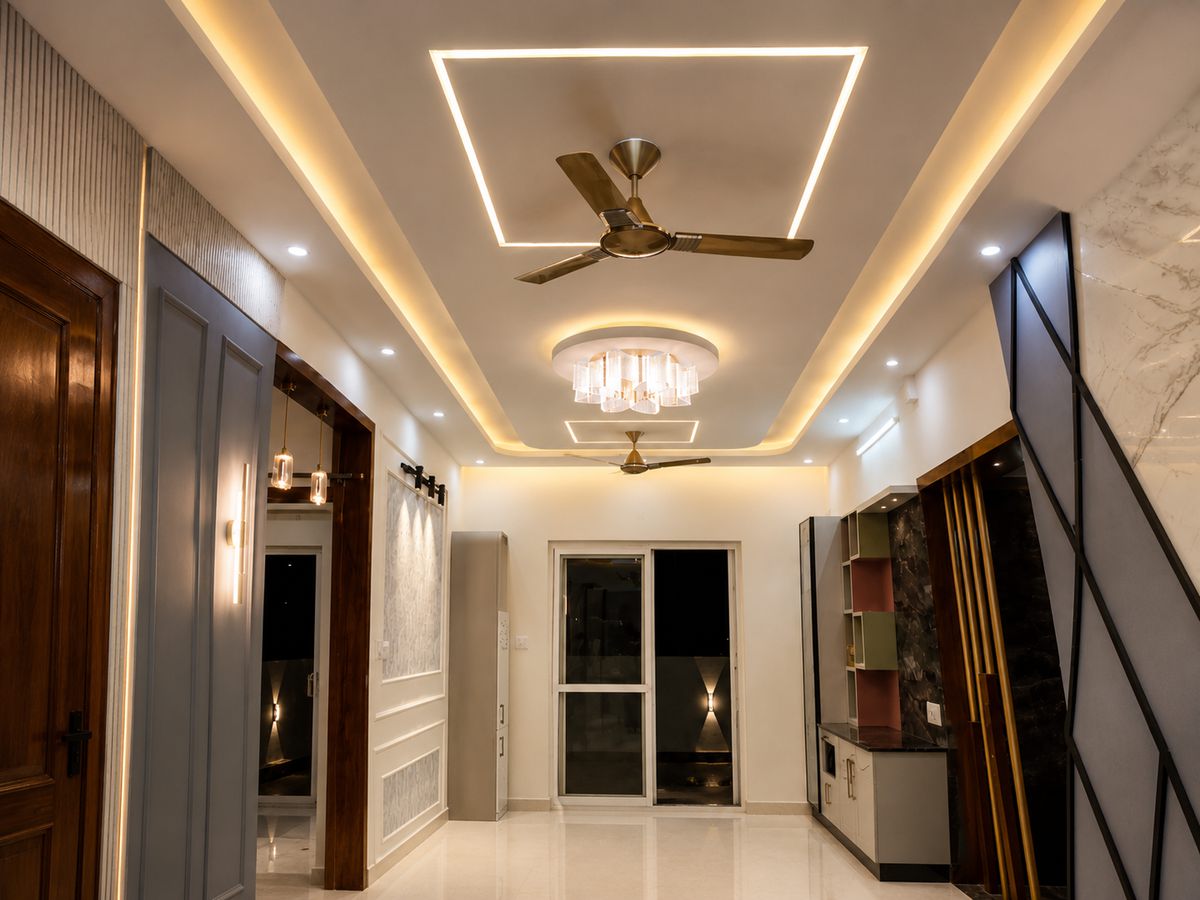
The day you take possession is the one day you have real leverage. Once you have signed the handover and paid the final instalment, every defect becomes your problem and your cost. An unhurried two-hour inspection now can save months of arguing later — and it decides how much remedial work your interior budget quietly has to absorb.
Here is what to check before you accept a new flat in Bengaluru (Bangalore), in the order that makes sense on site.
Carry these with you
- A phone with a good camera — photograph every defect with something for scale.
- A socket tester (₹200–400 online) — tests earthing and polarity in seconds.
- A small marble or a spirit-level app — for checking floor slope.
- A coin or key — for tapping tiles.
- A measuring tape — verify the carpet area and note room sizes for your designer.
- A phone charger — the simplest way to test a socket actually delivers power.
Walls, ceilings and paint
Look along walls at a shallow angle with the light behind you — undulations show up immediately that way. Check for hairline cracks, especially where walls meet columns and beams, and around window edges. Look for damp patches or discolouration on ceilings and on walls shared with bathrooms; in Bengaluru these usually appear after the first heavy monsoon, so any staining now is a warning sign, not a cosmetic issue.
Floors and tiles
Tap every tile with a coin as you walk. A hollow sound means the tile has not bonded and will crack or lift later — mark those and list them. Check that grout lines are even, corners are not chipped, and that floors slope towards drains in bathrooms and balconies but are level everywhere else. Roll a marble across the living room: it should not run decisively in one direction.
Doors and windows
- Open and close every shutter fully — it should not drop, scrape or spring back.
- Check locks, latches, handles and stoppers actually work.
- Look at the gap between door and frame — it should be even top to bottom.
- Check window seals and drainage weep holes, and whether there is provision for mosquito mesh.
- Main door: confirm the frame is solid and the lock is a decent make, not a builder-grade filler.
Electrical — test every point
This is where a checklist saves the most money, because rework after your woodwork is installed is painful. Plug the tester or charger into every single socket. Then:
- Count the points room by room and compare against the agreed drawing.
- Check the distribution board is labelled, and trip each MCB to confirm it controls what the label says.
- Confirm earthing is present — this is a safety issue, not a nicety.
- Verify AC points exist where you will actually put an AC, and that there is a dedicated point for a geyser, chimney and hob.
- Note socket heights — a socket that will sit behind a wardrobe or under a kitchen counter needs to be moved before carpentry starts.
Plumbing and water
Run every tap and shower together for a few minutes and watch pressure. Fill and drain each sink and floor trap to check the slope — water should not pool. Flush every WC. Look under sinks and behind the WC for damp. Check that hot-water lines are actually run where you expect a geyser, and ask where the overhead tank and sump are and how supply is scheduled — water logistics vary a lot between Bengaluru projects.
Kitchen and bathrooms
Check the counter is level and the sink cut-out is clean. Confirm there is an exhaust or chimney provision and that the duct actually goes somewhere. In bathrooms, look for the waterproofing detail at the door threshold and check that the shower area drains properly. Any tile or slope defect here is far cheaper to fix before your units go in.
Balcony and drainage
Bengaluru rain is horizontal as often as it is vertical. Check the balcony floor slopes to the drain, the drain is not already blocked with construction debris, and the railing is at a safe height and firmly fixed. Look at the underside of the slab above for seepage marks.
Documents to collect
Paperwork is part of possession, not an afterthought:
- Occupancy Certificate (OC) — do not treat this as optional.
- Completion certificate and the possession letter itself.
- As-built electrical and plumbing drawings — your interior designer will genuinely need these.
- Warranty documents for lifts, pumps, waterproofing and any fitted appliances.
- Khata, tax paid receipts and the maintenance handover details.
Make a snag list, in writing
Compile everything into a single numbered list with photographs, share it by email so there is a record, and ask for a committed date against each item. Keep a copy. Builders fix documented, dated lists far more reliably than verbal complaints.
Then — and only then — start interiors
It is tempting to start design work the week you get keys. The sensible sequence is to get snags closed first, because tile replacement, electrical shifting and damp treatment are all messy jobs that destroy finished woodwork. Use the waiting period productively: measure up, fix your budget and get your layout and 3D design agreed so production can begin the moment the flat is clean. Our process page sets out how that runs.
Key takeaways
- Inspect before you sign — after handover, every defect is your cost.
- Tap every tile, test every socket, run every tap.
- Photograph defects and submit one dated, numbered snag list by email.
- Collect the OC and the as-built drawings; your designer will need them.
- Close snags before interiors start — remedial work ruins finished woodwork.